



Your Enneagram type is more than a personality label — it’s your whole strategy for life, and it points straight to your shadow. For men, the real work is using it to walk the four stages of male maturity, from denial to integration.
This post is also available as a YouTube video (click here).
Or jump to the audio version.
So, you have your Enneagram number. So what? (And if you don’t, read on, you’ll find it below.) Here’s a question that tells me more about a man than his Enneagram number ever could. Not which type are you? That’s the superficial layer — it plays back to you what you are, and that’s easy; plenty of personality tools do that. The real question is this:
What can’t you afford to feel, be, or do?
Because once we know that, we know so much more about you. We know what drives you. And that connects the dots. It tells us why you do what you do. And that’s the layer where you can do something about it, where you can make the changes you need to improve your personal effectiveness, or get your life back on track.
Every single Enneagram type — all nine of them — is built around one thing: a feeling or behaviour that a man learned very young he had to keep off the table to stay safe, to prove himself, to be accepted, to be loved. And here’s the hidden fact: uncovering that one forbidden thing is your biggest leverage point in the whole game of life. That’s what we’re really after.
A strategy for life
Here’s an example: let’s say you grew up in an incredibly strict household, one where obeying the rules was not just important, but the Number One Thing. To survive in that environment—and belong, be accepted, etc—you would have avoided breaking the rules. Duh. Your strategy was to be the good kid, the one who followed all the rules. You took that with you to school, and everywhere you went. Right into adulthood.
Or maybe you were so bad at keeping the rules that you took it in the other direction. You actively rebelled. To survive, you had to escape, either literally out the window at night, or into your imagination, where you fantasised about the great things you’d do one day. That’s another strategy, and you took that with you to school. You became the rebel, the disrupter, maybe the one with all the ideas and imagination.
Your avoidance became a strategy, which became your personality, which shows up in your Enneagram type.
Can you see how your avoidance became a strategy, which became your personality, which shows up in your Enneagram type? And what you’ll discover here is that the Enneagram points back to that avoidance, and helps us to undo the whole mess. And by mess I don’t mean you’re going to change. You’ll still have that same strategy and personality, but you’ll be better placed to use its positive side, and not be a victim of its downside. If you’re the rules guy, you can learn to be less rigid. If you’re the rebel guy, you can learn to be more grounded and stop trying to escape your adult life.
The short version. Every Enneagram type is organised around one thing a man avoids — a feeling or behaviour he learned to keep off the table. That avoidance is the raw material of his shadow (Jung’s word for the disowned self), and a defence mechanism keeps it hidden. The four stages of male maturity — red, white, grey, black — are the timeline on which the shadow is built, defended, and, if he does the work, integrated. Integration isn’t becoming a better or different man; it’s allowing back what you shut out — which feels like loss and turns out to be expansion.
This is part of a wider body of work on men and maturity — how we actually grow up, and all the ways we get stuck. I’m Neil Bierbaum, an Enneagram practitioner, and I’ve used this material in my Coaching for Men practice for more than a decade.
The four stages of male maturity
Separate from the Enneagram, I’ve developed a framework I call the Four Stages of Male Maturity. I cover it in depth in a companion piece — The Four Stages of Male Maturity — so here’s the short version. To reach real fulfilment and wisdom, a man has to negotiate these four stages. The problem is that many don’t. They get stuck — especially now, when we’ve lost the traditional markers that used to move men along.
The work that a man must do to move successfully through the four stages of maturity is shadow work: he must integrate his shadow – that very thing that the Enneagram points to. The Enneagram can help you do that work by revealing the theme of your individual shadow, and therefore what the great arc of your journey to maturity is all about. That’s where these two models come together.
Here, briefly, are the Four Stages of Male Maturity:

Red (roughly 16–25): rebellion. Testosterone and defiance and energy that needs somewhere to go. By this stage your Enneagram strategy is starting to become visible, though you may have a good disguise for it under that cool exterior. It’s unlikely you’ll be naming your avoidance with any great awareness.

White (mid-twenties to mid-thirties): compliance. The white knight. Your strategy is solidifying, and you’re starting to get behind it as the real thing — as you. You now represent the establishment you used to rebel against; you uphold the rules you used to break — and you defend them, usually a little too hard. At this stage you’re likely to be merged with your avoidance and treating it like it’s your best friend. It still seems to be working for you.

Grey (late thirties to mid-fifties): integration. The strategy that got you this far quietly stops working, and everything you’ve been avoiding starts breaking through the floor. Life is trying to show you that the strategy is limited, that you need to expand. This is where things get messy — and where you face a choice: double down on the strategy, or let the new information in. It’s the stage of the so-called midlife crisis, which can be a far smoother transition if you let that information in.

Black (56 and up): wisdom. Having taken back what you threw away, you can finally hold both sides at once. You can be firm and forgiving, driven and content. Now — not every man makes it to black. Some don’t even make it to grey. They get stuck in white, just going harder and harder at a strategy that’s failing. Some panic, bolt back to red, and buy the motorcycle. The interesting question is: what, exactly, does each man have to pick back up to move on? And that’s where the Enneagram is genuinely brilliant.
The nine Enneagram types: what each man avoids, and the shape of his shadow
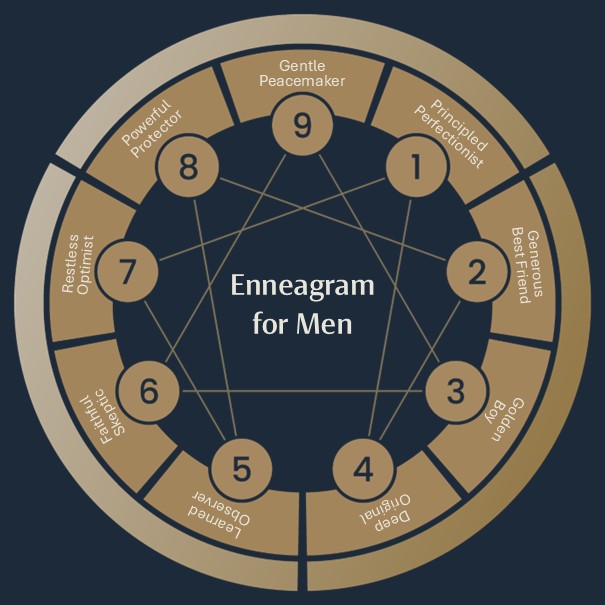
Here’s the part you came for. Nine types, the same move run nine times: what each one avoids, and so the exact shape of his shadow — and the path back. See if you can spot yourself. The table is the quick version; the detail — with links to per-type articles — follows underneath.
| Type | What he avoids | The shadow he disowns | His integration path |
|---|---|---|---|
| Type 1 | The Principled Perfectionist | Breaking rules; falling short of standards | His own “bad behaviour” — the rule-breaking desires he denies | Turn hard rule-keeping into flexible guiding principles |
| Type 2 | The Generous Best Friend | His own needs | His own “selfishness” — any attention paid to himself | Put on his own oxygen mask before helping others |
| Type 3 | The Golden Boy | Failure; anything less than winning | The real self beneath the highlight reel | Learn to share the spotlight |
| Type 4 | The Deep Original | The ordinary; being “just a number” | His own ordinariness | Find the extraordinary in the ordinary |
| Type 5 | The Learned Observer | Social exposure; not knowing | “Being stupid” — connection and fun for their own sake | Like Scrooge, discover the meaning of Christmas |
| Type 6 | The Faithful Skeptic | Risk and danger | His own easy-going, free-flowing, untrustworthy side | Trust that life sometimes plans better than you can |
| Type 7 | The Restless Optimist | Restriction; negative experience | Depth, and slow engagement for a result | Walk the earth’s plane, one step at a time |
| Type 8 | The Powerful Protector | Weakness; loss of control | The soft, unprotected boy under the armour | Like Mandela, let even your enemy have a say |
| Type 9 | The Gentle Peacemaker | Conflict | His own life force — his wants and needs | Set out his stall and find people still buy |
Type 1 — The Principled Perfectionist
Avoids breaking rules — including the rule that a man shouldn’t get angry — and falling short of standards, whether quality, moral or ethical. Others may avoid this too, but for him it’s the main thing. So his shadow is his own “bad behaviour”: any secret desire that would mean breaking a rule if he pursued it. The clue is in all the rule-breaking he polices so hard in everyone else. His integration path is to turn hard rule-keeping into flexible guiding principles. Read the Type 1 guide →
Type 2 — The Generous Best Friend
Avoids his own needs. Others sacrifice for people too, but for him it’s the main thing — he helps to the point of self-neglect. If you’ve ever watched Queer Eye, most of the men being made over are this type: unkempt hair and beard, scruffy clothes, chaotic house, because he’s the schoolteacher or the sports coach running around after everybody else. His shadow is his own “selfishness” — which, in his mind, is any attention paid to himself, any asking for what he wants or needs. That would make him look selfish, and he can’t have that. His integration path is to put on his own oxygen mask before he helps everyone else. Read the Type 2 guide →
Type 3 — The Golden Boy
Avoids failure — which for him is anything less than winning, than being number one. His greatest concern is reputation, and he cultivates it deliberately. So he’ll always look the part and be the best; and if he can’t, he simply won’t go there. His shadow is the real self underneath the highlight reel — the things he’d feel, say and do if his own feelings ever mattered a damn over what other people admire. His integration path is learning to share the spotlight. Read the Type 3 guide →
Type 4 — The Deep Original
Avoids the ordinary — being just a number, one of the crowd. It shapes his choice of career as much as the way he solves problems, even the way he dresses. He carries genuine inner depth and sensitivity, qualities that don’t match the brutality of the outside world, so at times he can feel broken by the mismatch. His shadow — surprisingly — is his own ordinariness: being just a number, like everyone else. His integration path is to find the extraordinary in the ordinary. Read the Type 4 guide →
Type 5 — The Learned Observer
Avoids social exposure, and not knowing. The two collide when he’s asked to make an impromptu presentation or stand at a cocktail party making small talk — both of which he considers a waste of his limited time and energy, pulling him away from his real research or knowledge work. So his shadow is “being stupid”: partly being caught not knowing something, but even more, giving his scarce time and energy to “stupid” activities or people — connecting for the sake of connecting, having fun for the sake of having fun. His integration path is akin to Scrooge’s: discovering the meaning of Christmas. Read the Type 5 guide →
Type 6 — The Faithful Skeptic
Avoids risk and danger, which he mitigates through excessive planning and through demonstrating — and cultivating — loyalty. His shadow is his own easy-going, free-flowing, sometimes untrustworthy nature. His integration path is to recognise that sometimes, when you let it, life has better plans than you could ever make. Read the Type 6 guide →
Type 7 — The Restless Optimist
Avoids negative experiences and people, especially ones that impose restrictions of any kind. He’ll want to escape or bypass them immediately and get to the next exciting — read: positive — thing. So his shadow is serious depth, and the long, slow engagement it takes to actually produce a result. His integration path is learning to walk the plane of the earth — to get somewhere by putting one foot in front of the other. Read the Type 7 guide →
Type 8 — The Powerful Protector
Avoids being weak or vulnerable — which can mean handing control of a project to someone else as much as it can mean showing a soft side. The world is a dangerous place; you have to be tough to survive, and do things your way to get results. His shadow is the soft, unprotected boy underneath all that armour. His integration path is to walk the path of a Mandela: letting even your enemy have a say in your solution. Read the Type 8 guide →
Type 9 — The Gentle Peacemaker
Avoids conflict, which he frames as a purely destructive — never constructive — force that leads only to the breakdown of relationship. So his shadow is his own life force, which carries his wants and needs, and which, if expressed, would put him at odds with others. His integration path is learning to set out his stall in the busy marketplace and discover that people will still buy from him. Read the Type 9 guide →
You can probably sense which one is you. It’s also possible that two of them speak to you — and that’s fine; explore both. I’ve run more than 500 debriefs, and the data is clear: we all have elements of all nine types. The question is always which is your main thing — that’s your dominant type. Some people have two that sit very close and show up in different scenarios. In fact, I prefer to call these personality styles rather than types, because “style” points to a preference rather than a box you’ve been shoved into. I’m sticking with “types” here only because that’s the word people know.
How to work with your Enneagram type
What we’re doing here isn’t orthodox Enneagram teaching. You’ll meet Enneagram purists who insist you can only have one type, that you must work with the lines and the arrows, and so on. I’m more interested in what actually works — and what I’ve seen work is exactly this: look at the shadow implied by the type, then walk the path of integration, bringing back the feeling and behaviour that got shut out and needs to come home.
Here’s a brief side note. In pure Enneagram terms, integration means moving forward to take on the positive attributes of another type, in the direction of the arrows. For example, in Enneagram speak, you’ll hear, “One integrates to Seven”, meaning the critical, rule-bound Type 1 (our Principled Perfectionist) learns to see things more positively, and to be less rigid about rules, which are typical Type 7 (Restless Optimist) traits. However, that means having to learn about that other type. Drawing on the Jungian concept of the shadow has the same outcome, but lets us remain within the Type and it aligns with the Four Stages of Maturity framework.
Integrating the shadow is not about becoming a different type. It’s about allowing — letting in the stuff you’ve been avoiding or denying.
Integrating the shadow is not about becoming a different type. That’s never going to happen. The generous Two is never going to turn into an image-conscious Three. It’s also not about flipping into the opposite of your type: the passive Nine is never going to become like a domineering, action-oriented Eight. It’s about allowing — letting in the stuff you’ve been avoiding or denying. Doing that feels like a loss at first, but you soon discover it’s an expansion. You widen your range of possible responses to any situation.
Your strategy needs to change
You start out in life being a little one-sided — quite pronounced in your type. Life lets you get away with it when you’re young — in the red and white stages. But eventually it stops, and says it’s payback time. Life — in the form of your wife, your kids, your colleagues, your customers — starts handing you evidence. It says, here are the results you’ve been getting. Can you see the patterns? They’re not there because life is unfair; they’re there because you keep treating life the same way you found it as a kid. You’re not a kid anymore, and the big world out there isn’t the world you grew up in. So get with the program.
That defence was necessary back then, but it’s no longer keeping you alive; it’s keeping you from living a full life.
You no longer have that same parent breathing down your neck about how you’d better succeed or else, or punishing you every time you break a rule. You no longer live in the house with the siblings who bullied you, or the unreliable parent who made you hypervigilant about what might go wrong next. That defence was necessary back then. It probably kept you alive — in fact, that’s most likely how your brain filed it: as a survival mechanism. But that’s not what it is now. It’s no longer keeping you alive; it’s keeping you from living a full life.
You can’t rush the journey
And you can’t rush this — you Threes and Sevens and Eights who are so impatient. Maybe you can accelerate it with some coaching, but you can’t skip to the next stage before you’re ready. You have to live the journey. In red, you spend the energy of your type freely. In white, you build the mask — and over-defend it. Grey is where the shadow comes home; by then the evidence has piled up at your door and you have to deal with it. And black is where a man can finally hold his own contradictions, and everyone else’s, with a bit of humour about the whole thing. You don’t get to black by becoming a better white knight. You get there by integrating what the white knight could never afford to be. That’s the whole path.
Where to start
Read the companion map that holds all of this together — The Four Stages of Male Maturity — and then read your own type in full. Then come back and take a deeper look at the type descriptions above and see which one is you. Be honest with yourself – it’s about who you are, based on evidence, not who you’d like to be or how you like to see yourself. If you’re not sure, ask those around you. Your children will be the most honest. And then your spouse, work colleagues, friends, in that order. Maybe you find more than one type fits, that’s fine, but keep it down to two, max three. Then link to the companion articles and go into each type in more depth. From there you can link to the paid reports, which take it further still.
Each report describes how your type tends to show up at every one of the four stages of maturity — so you can gauge how far you’ve developed, and what the next phase of your growth is likely to look like. If you’re younger, it’s a heads-up for what your forties and fifties may bring, so it doesn’t blindside you. If you’re older, it may explain a great deal about what you’re going through right now — and what to do about it. Finally, if you’d like to go further, you can work with me directly.
Enneagram for Men: Frequently Asked Questions
What is the Enneagram, in plain terms?
A map of nine personality types — or, as I’d rather put it, nine styles — each organised around one thing a person learned to avoid. It’s more useful than many personality assessments because it points to the strategy running underneath the traits, not just the traits themselves.
Is there a best Enneagram type for men?
No. There’s no good number and no bad one — only a more mature or less mature version of each. What matters isn’t your type; it’s how far you’ve travelled inside it.
How does the Enneagram relate to Jung’s shadow?
Your Enneagram area of avoidance is the raw material of your shadow. The Enneagram’s gift is precision: it tells you, type by type, roughly what your shadow holds and which defence you use to keep it hidden. The cure Jung named — integration — is the same for all nine.
What does “integration” mean in relation to Enneagram types?
Conventionally, the Enneagram’s “direction of integration” means moving forward along the arrows to absorb (integrate) some of the positive traits of another type. For example, the strict, critical One “integrates to Seven”, meaning they start to see opportunity and challenge the rules the way a Seven does. To accomplish this, one must “move into their area of avoidance”, which equates to the Jungian process of integrating one’s shadow.
Neil Bierbaum is an Enneagram practitioner and leadership coach with more than 20 years in practice and over 500 type debriefs. He’s the creator of the Four Stages of Male Maturity framework — adapted from the work of Carl Jung and Robert Bly — and The Enneagram for Men, mapping each type’s path through the stages of maturity and the work of shadow integration.
Audio Version
Listen to the audio version of this blog post:
FIND OUT MORE

For more information and/or coaching to improve your relationship skills, try any one of the following options:
- Read any one of the books in my Personal Effectiveness series, available in paperback and eBook formats. Details at this link.
- Sign up for an online self-coaching course at this link.
- Enquire about Coaching for Men at this link.
- To explore your unique path to maturity as a man, visit The Man Matrix.
