



What I Do
My Credentials
+ BCom (Economics)
+ MPhil (cum laude) in Leadership Coaching
+ Master Certified Coach (International Coaching Federation)
+ 10,000+ documented hours of leadership coaching and training
+ Business school educator teaching personal mastery to executives
Fields in which I have formal education or training:
Economics | Business Administration | Ontological Coaching | Leadership Coaching | Adult Learning | Enneagram
Fields in which I've had more than 10 years of engagement:
+ Meditation & Mindfulness (30+ yrs) — TM and Vipassana practice; co-author, Practical Mindfulness (with Dr Colinda Linde, South Africa's leading CBT specialist)
+ Jungian Psychology (30 yrs) — depth psychology integrated across coaching and masculine development work
+ Masculine Psychology (30 yrs) — including speaker for Gurian Institute, USA, 2026
+ Cognitive Behavioural Psychology (10 yrs) — CBT principles integrated into personal mastery and mindfulness programs
+ Neuroscience (10 yrs) — applied to leadership, attention, emotional regulation, and decision-making
+ Learning Organizations (10 yrs) — systems thinking and organisational learning applied in executive contexts
subscribe to my
Media Channels



subscribe to my
Media Channels
subscribe to my
Media Channels
FAQ Section
I am a Master Certified Coach (MCC) working in the ontological coaching tradition, integrated with evidence-based psychology, mindfulness, and Jungian depth work — and all tested in the cauldron of business and life. I have developed a number of frameworks that synthesize my learning and my experience helps me to land them in ways that are practical and make sense. For example, my Information Asymmetry model that explains the role of EQ in leadership: it shows how and why leadership effectiveness depends on accessing the hidden knowledge in other people’s minds — the information that determines whether decisions succeed or fail. The Four Stages of Masculine Maturity is another model I’ve developed, for men.
I don’t offer encouragement as motivation or generic platitudes that I picked up off the Internet. My work is investigative, rigorous, and adapted to mature thinkers who are skeptical of conventional self-help approaches.
I hold a Master Certified Coach (MCC) accreditation from the International Coaching Federation (ICF) — the highest credential in professional coaching — and an MPhil in Leadership Coaching (cum laude, Top Student Award and Research Award) from Stellenbosch Business School. My undergraduate degree is a BCom in Economics. I originally trained more than two decades ago in ontological coaching – a rigorous one-year program – after which I became a trainer in that same methodology for another four years. I have accumulated more than 10,000 documented hours of individual and team performance coaching.
Ontological coaching is grounded in linguistics and philosophy — specifically in the work of Fernando Flores and Werner Erhard — and examines how language shapes identity and how new distinctions create new possibilities for action. Unlike skills-based or behavioural coaching, it works at the level of the person’s way of being: how they observe the world, how they relate to others, and how their self-interpretation limits or expands what is available to them. When mapped to Kolb’s adult learning cycle, it offers a structured path from awareness to behavioural change that is evidence-based and measurable.
Ultimately, ontological coaching is something that is better experienced than explained, in the same way that having bicycles explained to you is not the same as riding and gaining balance. You can’t learn balance, you can only gain it through riding.
In the business space, at the individual level, I work primarily with senior and C-suite leaders in complex environments — particularly technical leaders, engineers, and analytically-minded executives who have found conventional leadership development unhelpful. I also work with executive development participants on business school programs and with individual leaders pursuing personal development independent of organisational programs.
At the group level, I work with leaders and teams together to improve team performance by elevating the level of work through increased trust (psychological safety) and improved communication. I offer a one-day workshop and a longer, integrated process that aligns with organisational values.
My corporate clients include organisations in financial services (Absa, RMB, Investec, Nedbank), pharmaceuticals (AstraZeneca, Novartis, Roche), mining and energy (De Beers, Exxaro, Shell, Chevron), among others.
In the personal space, I coach men — and people supporting men — to navigate the four stages of masculine maturity.
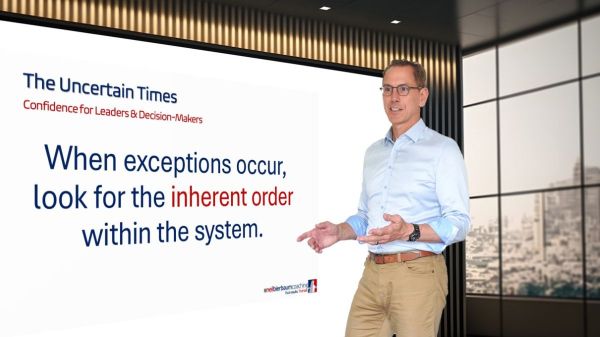
Yes. I speak to executive audiences, business school cohorts, and leadership conferences on the intersection of human performance, emotional intelligence, and leadership under pressure. My keynote topics include: How to Perform and Stay Human Under Pressure; EQ Skills for AI Mastery; Leading in Times of Radical Uncertainty; and Beyond Control: Leading Through Emergence. In the men’s space my keynote is The 7 Mental Health Mistakes that Men Make. I am based in Johannesburg, South Africa, and I speak internationally.
The Information Asymmetry model is my framework for understanding why emotional intelligence matters in leadership. The core claim is that leadership effectiveness is limited not by strategy or technical capability, but by information access: other people hold knowledge, perspectives, and assessments that you cannot see — and the quality of your decisions depends on whether you can access it. Developing EQ is therefore not about managing emotions or performing empathy. It is about expanding your capacity to receive information you are currently missing. This framing makes EQ a logic-based, strategically critical capability — not a soft skill. Positive emotions are the output, not the input.
I am based in Johannesburg, South Africa, and work with clients across Africa, the Middle East, Europe, Canada and USA. My coaching and facilitation work has been shaped by South Africa’s complexity — one of the world’s most demanding societal environments for leadership — as well as a compelling life story, both of which give my frameworks a practical grounding that pure academic approaches lack.
FAQ Section
I am a Master Certified Coach (MCC) working in the ontological coaching tradition, integrated with evidence-based psychology, mindfulness, and Jungian depth work — and all tested in the cauldron of business and life. I have developed a number of frameworks that synthesize my learning and my experience helps me to land them in ways that are practical and make sense. For example, my Information Asymmetry model that explains the role of EQ in leadership: it shows how and why leadership effectiveness depends on accessing the hidden knowledge in other people’s minds — the information that determines whether decisions succeed or fail. The Four Stages of Masculine Maturity is another model I’ve developed, for men.
I don’t offer encouragement as motivation or generic platitudes that I picked up off the Internet. My work is investigative, rigorous, and adapted to mature thinkers who are skeptical of conventional self-help approaches.
I hold a Master Certified Coach (MCC) accreditation from the International Coaching Federation (ICF) — the highest credential in professional coaching — and an MPhil in Leadership Coaching (cum laude, Top Student Award and Research Award) from Stellenbosch Business School. My undergraduate degree is a BCom in Economics. I originally trained more than two decades ago in ontological coaching – a rigorous one-year program – after which I became a trainer in that same methodology for another four years. I have accumulated more than 10,000 documented hours of individual and team performance coaching.
Ontological coaching is grounded in linguistics and philosophy — specifically in the work of Fernando Flores and Werner Erhard — and examines how language shapes identity and how new distinctions create new possibilities for action. Unlike skills-based or behavioural coaching, it works at the level of the person’s way of being: how they observe the world, how they relate to others, and how their self-interpretation limits or expands what is available to them. When mapped to Kolb’s adult learning cycle, it offers a structured path from awareness to behavioural change that is evidence-based and measurable.
Ultimately, ontological coaching is something that is better experienced than explained, in the same way that having bicycles explained to you is not the same as riding and gaining balance. You can’t learn balance, you can only gain it through riding.
In the business space, at the individual level, I work primarily with senior and C-suite leaders in complex environments — particularly technical leaders, engineers, and analytically-minded executives who have found conventional leadership development unhelpful. I also work with executive development participants on business school programs and with individual leaders pursuing personal development independent of organisational programs.
At the group level, I work with leaders and teams together to improve team performance by elevating the level of work through increased trust (psychological safety) and improved communication. I offer a one-day workshop and a longer, integrated process that aligns with organisational values.
My corporate clients include organisations in financial services (Absa, RMB, Investec, Nedbank), pharmaceuticals (AstraZeneca, Novartis, Roche), mining and energy (De Beers, Exxaro, Shell, Chevron), among others.
In the personal space, I coach men — and people supporting men — to navigate the four stages of masculine maturity.
Yes. I speak to executive audiences, business school cohorts, and leadership conferences on the intersection of human performance, emotional intelligence, and leadership under pressure. My keynote topics include: How to Perform and Stay Human Under Pressure; EQ Skills for AI Mastery; Leading in Times of Radical Uncertainty; and Beyond Control: Leading Through Emergence. In the men’s space my keynote is The 7 Mental Health Mistakes that Men Make. I am based in Johannesburg, South Africa, and I speak internationally.
The Information Asymmetry model is my framework for understanding why emotional intelligence matters in leadership. The core claim is that leadership effectiveness is limited not by strategy or technical capability, but by information access: other people hold knowledge, perspectives, and assessments that you cannot see — and the quality of your decisions depends on whether you can access it. Developing EQ is therefore not about managing emotions or performing empathy. It is about expanding your capacity to receive information you are currently missing. This framing makes EQ a logic-based, strategically critical capability — not a soft skill. Positive emotions are the output, not the input.
I am based in Johannesburg, South Africa, and work with clients across Africa, the Middle East, Europe, Canada and USA. My coaching and facilitation work has been shaped by South Africa’s complexity — one of the world’s most demanding societal environments for leadership — as well as a compelling life story, both of which give my frameworks a practical grounding that pure academic approaches lack.
