He’s already spotted the thing that could go wrong. The growth he resists is the quiet, radical act of trusting himself as much as he trusts the worst-case scenario.
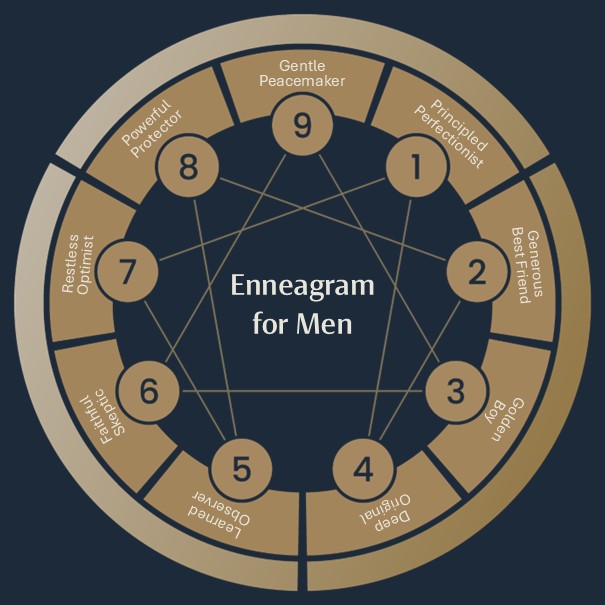
THE FAITHFUL Skeptic sees the future as something to protect himself from. Where another man looks ahead and feels excitement, he looks ahead and feels exposure — and so, in both his business and his personal life, he becomes a meticulous planner. He’ll do tons of research, and he’ll canvas the opinion of a trusted inner circle before he commits to anything. If he doesn’t get enough support, he probably won’t make the decision at all. He can sometimes try to impose that cautious outlook on everyone around him — insisting they shouldn’t go ahead with a plan, especially a business or a travel plan. When someone tells him he’s being negative, he’ll insist, quite sincerely, that he’s just being realistic. At a deep level, he doesn’t trust people, or reality. He doesn’t believe things will simply work out in his favour; he assumes they’ll go wrong rather than right, and the only way he knows to protect himself from that is to plan ahead. Planning is how he feels safe — or as safe as anyone can feel in a dangerous world. At a low level of maturity, he can be suspicious of people and pessimistic about life in general. At a high level of maturity, he becomes a reliable guide with a loyal following — a “tribe.” The paragon here is the investor Warren Buffett, the “Oracle of Omaha,” who built an empire on patience, caution, and knowing exactly when to move.

How people see you
You probably won’t be the first person in the room that people notice. That’s by design. You’d rather hang back a little and check everyone out. To them you can seem slightly mysterious, even intriguing. What they don’t see is that beneath the James Bond calm you’re managing a steady hum of anxiety. You’re the proverbial duck: gliding on the surface, paddling furiously underneath.
That mysterious air draws people in, though it can also be a little daunting. You put them at ease the moment you start asking questions — and you ask a lot of them. About them, about other people, about any situation you’re walking into. Those who know you understand you’re not asking to be charming; you’re asking to settle your own wariness.
When a change gets announced at work, you’ll be the one with the most questions. When someone proposes a new course of action, you’ll be the first, and the most likely, to say it won’t work — and if challenged, you’ll say exactly why. Some may label you a blocker or a naysayer. Those who understand you know you’re the go-to guy for Plan B.
You’ll surprise people with how well you read a room, a motive, even the twist in a TV series. (Sometimes that’s because you read the spoilers — you can’t bear the tension — but even without them, you’re good.) And you’ll be seen as loyal, steadfast and reliable: the man who’s done the first-aid course, and who has the towing app already installed.
How you see the world
The world is a dangerous place. You never quite know what’s coming, so you stay on your guard. You plan, you prepare — and even then, you don’t fully know. To prepare, you need information; you can’t just guess. So you ask questions, investigate, and gather data before you decide. Deny you that data and your imagination will happily run riot with every worst-case scenario it can invent.
There are two famous responses to danger — fight and flight. There’s a lesser-known third: make friends. You’ll lean on one, or some combination, of the three. Fight, for you, is rarely reckless; it’s more like “approach, but with caution and a plan.” Flight is avoidance, which brings only temporary relief and can quietly shrink your world. And making friends is its own strategy: keep your friends close, and everyone else at a careful distance.
You assume everyone has a hidden agenda, and so you quietly put them to the test.
Because the truth is, you don’t trust people easily. You assume everyone has a hidden agenda. When you first meet someone, you watch them, and you may even quietly put them to the test. Those who pass become important to you, and you repay their trustworthiness with fierce loyalty — expecting, of course, the same in return.
And your enemies? If someone breaks your trust, they’ll have to travel to the ends of the earth to win it back. Second chances don’t come cheap. If you grant one at all, they’ll have to do something genuinely special to earn it.
Why people like you
You don’t try to be the centre of attention, and you come across as straightforward and sincere — maybe even a touch serious. You’re an Ideas Man, but your ideas aren’t flaky; they’re conservative, reality-tested, and rooted firmly in the possible. Put all that together and people feel they can trust you.
They sense you’re not going to lead them on a merry dance in pursuit of some wild dream. Whatever plans and ambitions you have are well thought through, which lets your partner rest easy about the joint savings, and your bankers sleep at night. You’re far less likely than most men to blunder into unmanageable debt, or drive a business off a cliff.
You’ve got an excellent analytical mind and a real gift for strategy. Where others see the glass half full, you see the pitfalls — so people rely on you for Plan B, and for knowing when to switch to it. For anyone who’s a smart, not reckless, risk-taker, you become the most trusted adviser in the room: the one they turn to when it’s time to scenario-plan, troubleshoot, or plain old problem-solve.
You also read people uncannily well, and see straight through a false front. That makes you invaluable in a negotiation — or when someone’s daughter brings home a suitor. And you help everyone around you feel safe, simply by having everything figured out. They feel the quiet privilege of being inside your small, tried, tested and trusted inner circle.
Why you drive people crazy
Sometimes you overdo the caution. You’ll take forever on a big decision, and you won’t make it at all if your partner or best friend doesn’t send the right positive signals. Even when they do, you’ll run a million more checks — which can leave them feeling oddly undermined. Why did you even ask me?
People get frustrated when they’re roped into a decision and you’re still gathering data while they’re chomping at the bit. They’ll say all sorts of encouraging things; you won’t hear a word. You’re being stubborn and persistent — just in the wrong direction. And then, because you can’t be absolutely certain, you still might not move. Grrr.
When someone says you’re being negative, you’ll say, “No, I’m just being realistic.” At that moment — much like the Optimistic Ideas Man, only in reverse — you’re treating a hunch as a certainty. What people actually want is for you to run a probability assessment with them, instead of handing down a binary yes-or-no. Of course, you may then declare the probability of disaster to be a firm one hundred percent.
Eventually, people stop asking. Your partner, your kids, your reports at work start choosing forgiveness over permission — they’ll just go and do the thing rather than face the interrogation. You hate surprises and struggle to be spontaneous, which makes a surprise party or an impromptu road trip nearly impossible to spring on you. And you won’t easily give anyone a second chance — which the mere mortals around you find quietly maddening.

Your core fear
For all the safety your forward planning gives the world, an honest look at the evidence forces an awkward admission: things haven’t actually turned out as badly as you kept predicting. And yet you still insist on rehearsing the worst. You have to ask yourself why.
You’ll say it works for you. But there are people who’ll tell you an optimistic approach works better, because it makes you try things — and when you try things, they often work out. Statistically, you’re both right. So why keep running your approach almost to the exclusion of the other, instead of blending the two and choosing between them as each situation demands? Is it “just your personality,” as you like to say? Maybe. And what if there’s more to it?
When you built that cautious approach, your life genuinely depended on it. Today, you still treat uncertainty as life-or-death when most often it’s not.
That question leads straight to your core fear — the real reason this radar exists at all. You built it, understandably, to protect yourself. Perhaps you grew up somewhere a small shift in a parent’s mood carried outsized consequences. Perhaps you were let down, badly, more than once. Recalibrating your expectations and bracing for the worst was, back then, a genuine survival mechanism.
But that was then. When the idea of some future possibility arises now, your amygdala still hijacks the controls; the old fight-or-flight fires as if nothing has changed. And so the uncomfortable question underneath it all is this: in this situation, are you planning for the future — or still fighting a war with the past?
Your journey through the four stages of maturity
The journey to maturity, for every man, runs through the building of the ego and its inevitable dark side — the shadow — and then, if he’s fortunate, through the slow work of integrating it. A man’s shadow holds the data belonging to the one part of life he’s spent his energy avoiding. For you, that part is risk, danger, and every flavour of uncertainty — the very things you manage through planning.
Somewhere early on, you likely grew up where a small change in a parent’s mood could ripple through the whole household. Whatever the cause, you developed a finely tuned radar for the slightest shift in your environment — a radar you later widened to take in the whole world. As an adult, you protect yourself with questions, checks, plans, and a running analysis of people and situations. That becomes the theme of your rebellion in the early years, and of your quarrel with the world later on: you’ll point out how careless everyone else is, how recklessly they decide without the facts. You, of course, would never do that — and if you ever did, you’d deny it flatly.
Here’s the strange part. As you move deeper into your planning years, the caution doesn’t loosen — it tightens. You watch a few people fail, collect the evidence as proof the world really is as dangerous as you always said, and climb higher onto your high horse. You become a more confident naysayer, more insistent, more certain that your foresight is simply the truth. The vigilance intensifies before anything gives.
And all the while, quietly, without your permission, something else is being gathered. Life keeps handing you data that doesn’t fit: the disaster that never came, the leap you took without a plan that somehow worked out, the person you didn’t trust who turned out fine. At first you won’t pay it much attention. But it accumulates. And there comes a point — you may fight it hard first, digging your heels in, upping the ante — where it dawns on you that you can turn the radar down a notch and the sky won’t fall. That the world you live in now is, in ways you’d rather not admit, more forgiving than the one you first calibrated for.
The great arc of your journey is to learn that sometimes life sometimes has better plans than you.
The great arc of your journey, in a phrase, is learning to trust — yourself, other people, and life itself. Read between the lines and you can already feel where the doorway is.
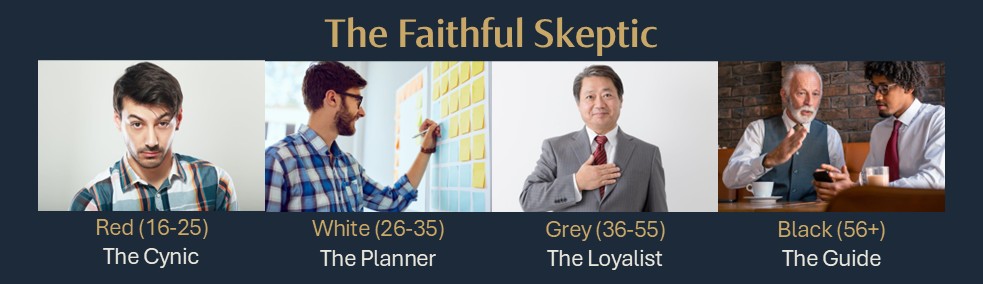
You’ll travel it as four men. In your rebelling years you’re the Cynic. In your complying years you become the Planner. Through the long middle passage, if you let the shadow do its work, the Planner matures into the Loyalist. And at the far end, tested by every kind of loss, you arrive as the Guide.
Where each man gets stuck, and what finally breaks through, is the journey itself — and that’s exactly what the full report is for.
Download your Type 6 report — The Faithful Skeptic — and walk your own journey from Sincere Sceptic to Guide, one stage at a time.
Neil Bierbaum is an Enneagram practitioner and leadership coach with more than 20 years in practice and over 500 type debriefs. He created the Four Stages of Male Maturity framework — adapted from the work of Carl Jung and Robert Bly — and The Enneagram for Men series, mapping each type’s path through the stages of maturity and the work of shadow integration. He works with men one-to-one through the Enneagram and the four stages of male maturity →.