He leads with force and protects his own — hard. The strength he hasn’t tried yet is the kind that can lower the guard, drop the armour, and let someone all the way in.
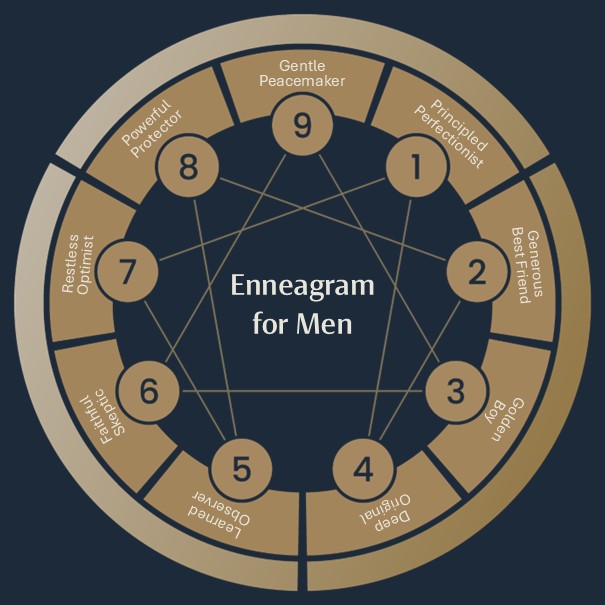
OF ALL nine types in this series, the Type 8 man — I’ll call him the Powerful Protector — is the most solid, practical and reliable. Also the most immovable. Solid as a rock. He has almost no need to describe or explain things; he’s about direct, immediate action. Suggest something to him and he probably won’t do it — but let the same thought arise in his own head and it turns into action almost before he’s finished thinking it. Because in his world, any thought that arose in his own mind deserves to be defended as the right way, the only way — or you can take the highway.
His saving grace? He’s a magnificent provider and protector who hates injustice and will offer all his considerable power to support the underdog. He likes to be in control, which means he’ll micromanage you mercilessly — at least until you prove yourself — and then get explosively angry if you try to micromanage him. Picture factory bosses, sports coaches mid-tantrum, and military generals: blunt, forceful, commanding.
Underneath all that armour, though, is the thing he most fears being exposed: a soft, vulnerable inner child who was never protected, and whose protection — through sheer bloody-mindedness — made him who he is. At his best, matured, he learns to leave people be and pour that powerful presence into causes far bigger than himself. Think Churchill. Think Mandela. This is the man who becomes strong enough to let others lead.

How people see you
People’s first impression of you is physical — and it isn’t your beauty and elegance that lands, so much as strength, solidness, and a low centre of gravity. Tall or short, lean or (more likely) not, you give off the impression of being rooted to the ground. Anyone imagining shoving you out of their way quickly works out they’d have better luck with a tree. In a crowd, you’re the one nobody messes with. Good luck to them.
Your personality matches the frame. You’re down-to-earth and proud of your tell-it-like-it-is, no-airs-and-graces approach. Why are people so sensitive? Why all the beating around the bush? Your dress sense is just as no-nonsense — nobody has ever accused you of being a dandy.
To call you ‘determined’ is sarcasm by understatement; most people mean ‘stubborn’ and are being polite. Good luck offering you an explanation that changes your thinking — on this, or on anything. Because if you think something, it stays thunk. It even makes the sound on the way out of your mouth. Thunk. You said it, therefore it’s true. You stand on your right to be right like nobody else.
And notice how often the word ‘do’ shows up in your vocabulary. Your solutions to everything — even tangled political questions — are relentlessly practical. Riots in the streets? You’re not theorising about root causes and grievances. You’re already saying, ‘Here’s what the government should do…’ There’s that word again. Do. Thunk.
How you see the world
You see the world as a harsh, cruel and unforgiving place. Life is tough, and you have to be tough to survive. This isn’t a philosophy you picked up; it’s a conclusion you earned early. Maybe a parent was absent — literally or figuratively — and you had to fend for yourself, possibly for your siblings too. Maybe a parent was very present, and brutalised you ‘for your own good,’ pushing you past your limits and belittling you when you complained.
So your creed runs: nobody’s going to look after you but yourself. Claim what’s yours and fight to hold it. Never back down — that’s weakness, and you can’t stand weakness. In your view, people need to toughen up, and pressure is the fastest Coach. It worked on you, didn’t it? And you’re proud of how you turned out.
You become convinced there’s only one right way — yours — and only one person who can be trusted to do it — you.
It’s not that you don’t have doubts, fears, or sensitivity to others. You just know how to shut them out — how to stop them getting in the way of what needs to be done. And here’s the payoff: shutting things out makes life simple. You can size up any situation, decide, and get things moving. That’s your genuine talent, and your solutions usually work.
The trouble is you become convinced there’s only one right way — yours — and only one person who can be trusted to do it — you. Yet let a real bully pick on someone who genuinely can’t defend themselves, and you’ll step in without a second thought. You won’t care who you’re up against, and you won’t just be saying it. Pretty much nobody scares you.

Why people like you
You embody the one masculine trait on the back of which cities, countries and empires were built: the ability to go forward despite everything. To stick to the plan. To stay on the mission when the risk is real and the wheels are coming off.
There’s an Afrikaans phrase, vok voort. Google Translate renders it, primly, as ‘continue’. The rest of us know what it really means. You can picture the Voortrekkers coming down the Drakensberg by wagon and living by that creed. South Africa’s Springboks play the same way — power over guile — and it’s won them three World Cups. As Martin Johnson once put it: ‘For the Springboks, when Plan A doesn’t work, they go to Plan A.’ If you laughed because that’s you, then you know we’re on track.
What you offer the world is certainty. Clarity. Firm decisions with no wavering and no vacillating. People always know what you’ve decided, and therefore what’s about to happen — a level of consistency nobody else can match. As the Springboks’ opponents say: you know what they’re going to do; the only question is whether you can live with it. The people in your orbit have that same limited choice.
As a partner or leader, your sheer force of will makes people feel safe. And that armour hides a soft, tender centre — one that might surface, oh, three times in a life: when your child is born, when that child marries, and when your grandchild arrives. Anything more is a bonus for the people close to you.
Why you drive people crazy
Every man’s strength, overplayed, becomes his weakness — and you’re no exception. Your certainty shows up as stubbornness. Not the academic stubbornness of the Learned Observer, nor the moral stubbornness of the Principled Perfectionist. Yours rests on nothing but the fact that the thought arose in your own mind. Thunk. Therefore, it’s so. There can be no other way, and you’ll defend it to the death — until the person across from you gives up. Debating you can be exhausting, exasperating, even quietly crushing.
Your need to control how things get done does something similar to the people around you. There’s research suggesting that when people are micromanaged, they carry cortisol levels comparable to soldiers in the World War I trenches. People need autonomy the way they need air; most would rather be involved in a decision and get it wrong than be told what to do and get it right.
Look at it systemically and you’ll notice you take up all the confidence space, all the decision space, and all the certainty space in the room. Would anyone dare crack a joke in front of a professional comedian? Precisely. So your kids and your team never get to find those qualities in themselves — and then you’re frustrated that it’s all on you. It’s a self-fulfilling prophecy, and you’re the prophet.
Offer feedback and you’ll hear two things: “I bend over backwards for them!” and, “They should just toughen up, the way I had to.” You might well scare off your challenger. That, by the way, is not a victory.

Your core fear
On the surface you’re the scary one — the guy who shows no fear and will tell you, flatly, that he’s afraid of nothing. At a physical level that’s probably true; you’ll take on anyone, especially a bully, and you’ve likely proved it more than once.
But to claim you fear absolutely nothing is like claiming you cast no shadow when you stand in the sun. It simply isn’t possible. And since you’re the no-nonsense, tell-it-like-it-is guy, let’s get to it. Your core fear isn’t out there in the world. It’s internal. It is to feel vulnerable and exposed in the way you were as a boy — back when you first discovered this power in yourself.
When you built that approach, your life genuinely depended on it. Today, you still react as though it’s about survival when most often it’s not.
Things weren’t getting done for you, so you got them done, by being forceful enough. Force gave you control; control shut out the vulnerability; and the whole thing became a spiral that’s been turning ever since. Somewhere in there you also learned that giving airtime to your own tender feelings didn’t help — so that got folded into the spiral too.
When you built that approach, your life genuinely depended on it. The problem is that today, the moment a situation threatens to slip out of your control, that same life-or-death alarm fires at gut level — what neuroscientists call an amygdala hijack. You react as though it’s survival. Take a breath and look around, though, and most of the time it isn’t. That quiet realisation is where the whole journey begins.
Your journey through the four stages of maturity
Every man’s road to maturity runs the same basic shape: first he builds an ego and its inevitable dark side — the shadow — and then, if he’s fortunate and willing, he integrates that shadow back in. Your shadow holds the one part of life you’ve spent your whole existence avoiding. For you, the Powerful Protector, that avoided thing is any hint of weakness in yourself, and, tied to it, any loss of control to other people.
You know where this began. As a boy you may have had to take care of yourself — and maybe your siblings, or even a parent — far too young. You discovered that if you were forceful enough, you got your way, even with adults. You tested it on the schoolyard bullies and perfected it, and you learned there was no room in that setup for so much as a flicker of vulnerability. You could crowd it out by sheer will, and by never thinking twice. As a man, you’ve kept avoiding it the same way: by asserting your authority as fast and as absolutely as you can.

But here’s the thing life does to men like you. Quietly, without your permission, you start gathering evidence that proves you wrong. Yes — wrong. Experiences pile up that don’t fit the harsh universe of your childhood. At first you won’t give them the time of day. Then, slowly, they start to break through. Something in you begins to suspect you no longer need to defend yourself the way you once did — that it might dawn on you, horror of horrors, that you can acknowledge your own vulnerability, and other people’s, and still be perfectly OK. That you can yield, and the sky won’t fall.
That’s the great arc: discovering that your strength isn’t diminished by vulnerability but enhanced by it. Picture the tree that survives the storm precisely because it’s strong at the core and flexible at the branches — it bends with the wind instead of fighting it, and so it keeps its leaves.
Now, don’t expect that softening to arrive on schedule. Counter-intuitively, as you head into your thirties you’re more likely to double down — to turn the volume up, not down. More control, more certainty, more my-way-or-the-highway. The shadow doesn’t knock politely; it waits until you’ve tried force from every angle, and only then, later, does it finally start breaking through.
That’s the great arc: discovering that your strength isn’t diminished by vulnerability but enhanced by it.
Your journey moves through four stages, and in each one you show up as a different man. In red, from sixteen to twenty-five, you arrive as the Rock — a rebel who takes no prisoners. Through your late twenties and early thirties you become the Boss, the white knight who’ll show you his way, or the highway. Grey, from your mid-thirties on, is where the real transition either happens or doesn’t — where you can grow into the Champion of the Underdog, or entrench as the Boss for the rest of your life. And black, from your mid-fifties, is reserved for the man who’s truly done the work: the Great Leader, strong enough, at last, to yield, give others a voice, even let others lead.
Where you get stuck in each of those stages — and exactly what it takes to break through — is the map you’ll find in the full report.
Download your Type 8 report to see how the Powerful Protector moves through the four stages from Rock to Great Leader, one stage at a time.
Neil Bierbaum is an Enneagram practitioner and leadership coach with more than 20 years in practice and over 500 type debriefs. He created the Four Stages of Male Maturity framework — adapted from the work of Carl Jung and Robert Bly — and The Enneagram for Men series, mapping each type’s path through the stages of maturity and the work of shadow integration. He works with men one-to-one through the Enneagram and the four stages of male maturity →.