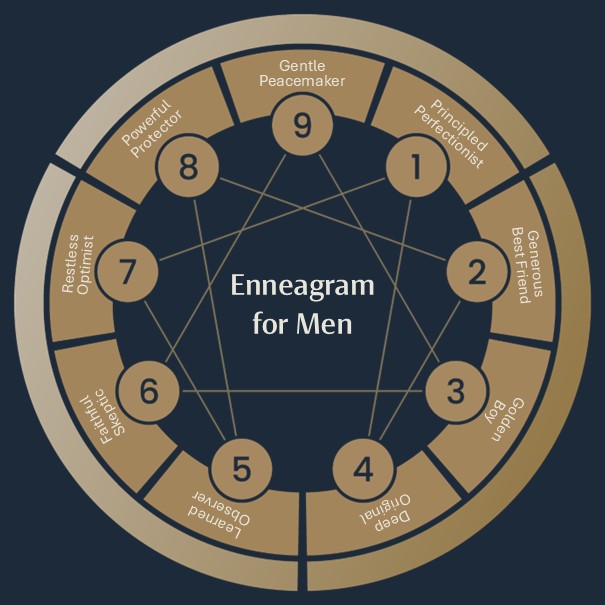
He holds everyone to a high standard — himself hardest of all. Maturity is where that firmness finally learns it can bend without the whole world falling apart.
THE PRINCIPLED Perfectionist has a moral orientation, which you could just as easily call a process orientation. These are the men we need to keep a check on everyone else — the scientists, the dreamers, the chancers, and, frankly, the rest of us. They do it by setting standards and creating processes — which are really just elaborate forms of rules — and then making sure everyone meets those standards and follows those processes. In other words, that everyone obeys the rules.
Think of the corporate compliance officer, the auditor, the policeman, the judge, the priest, the saint. Not that every man in those roles is a Type 1, nor that every Type 1 lands in that narrow range of careers. But at the very least, this is a man with an axe to grind about something moral or political.
At a deep level, he fears getting into trouble, or being criticised for any kind of mistake or moral transgression.
At a low level of maturity, he’s the ultimate white knight, always doing what he believes is “right” — even when it prejudices him — and strict and judgemental towards anyone who falls short of his standards. At a high level of maturity, he can become a great moral leader. The paragons — high maturity, moral orientation — are men like Gandhi and Martin Luther King, Jr. This article is about how that journey actually happens: how The Principled Perfectionist travels through the four stages of male maturity, and what it costs him to become firm enough to bend.

How people see you
If people wanted to spot you at, say, a book launch, they’d only need to be there at the exact time on the invitation. That’s when you’ll arrive — dressed appropriately, following every protocol without fuss. If anything, they’ll miss you, because you were five minutes early.
They might also catch you frowning — or glaring — at anyone who doesn’t follow protocol: the person who sneaks up the signing queue, the one who answers their phone during the speech. You’re big on people doing what’s “right,” not just what they “want.” You’re a little reminiscent of Tommy Lascelles in The Crown, keeping a tight lid on anyone tempted to express their individuality at the expense of the institution.
You show up proper — in manner, manners and dress, sometimes to the point of being “tight.” Your palette runs to solid panels, clean lines, black and white. Because that’s how the world is, right — everything either black or white? In an age when men no longer wear ties, there’s a good chance you still do, or at least keep the top button fastened.
If a colleague submits a report with spelling errors, you’ll send it back before you’ll even read the content — which can make you look harsh, unfair, critical. And you say no a lot, to others and to yourself. There’s far more to how the world reads you, and your full report unpacks the rest.
How you see the world
The world would be a much better place if everyone just followed the rules. Rules exist for a reason. We all agree to them, so why wouldn’t we follow them? If you don’t like one, there’s a process to change it. Until then, you abide by it. Simple. What’s not to get?
The world is, in fact, simple for you: things are either black or white. Right or wrong. Nothing is grey — at least, not until you mature and advance, ironically, through the grey stage. Your lens is either moral (right versus wrong in ethics or rules) or qualitative (right versus wrong in standards). And for quality you have exactly one setting: perfect.
Your eye picks up anything that isn’t perfect, and you feel compelled to comment on it or correct it.
Your eye picks up anything that isn’t, and you feel compelled to comment on it or correct it. That report with the errors? You can’t even bring yourself to read it. When people don’t stick to an agreed process — especially one you designed — you assume they must be doing it deliberately to annoy you. What other reason could there possibly be?
Here’s the twist that makes you rare: you apply the rules to yourself exactly as you apply them to everyone else, even when no one’s watching. If your teenager has to wait for their birthday to see that age-restricted film, then it’s only fair you wait for yours to buy the single malt that’s on special — even if it sells out first. Where that iron consistency comes from, and where it’s quietly taking you, is the real story.

Why people like you
In a word: honour. Without men like you showing the way, the world would long ago have lost its moral compass — and right now that compass is looking rather murky. You are its keeper, its torchbearer. In a world run on expedience, you show that it’s possible, and even desirable, to do the right thing when it’s hard.
You do for the world what a good Coach does for a classroom. Your mere presence brings order and sets the standard. The trouble is that your presence is needed to maintain it — the moment you leave, most people drift back to doing their own thing. To put names to it: you do for the world what Gandhi did for India, King did for America, and Mandela did for South Africa. And to make the point, look at what happened in each of those places once those men were gone.
At an individual level, you have obvious integrity. Your word is your bond, and people feel it — they instinctively trust you. If you say you’ll be somewhere, you will be, on time or early. You’ll tell the truth, sometimes to your own detriment.
You’re the man most likely to be a proper gentleman: opening doors, knowing which fork to use, finishing tasks, putting things back where they belong. And you’ll spot the inefficiency in a workflow no one else noticed, then build the better system — even when it isn’t your job. That instinct, at its best, is a genuine gift; your report shows you how to aim it.
Why you drive people crazy
In Game of Thrones, Jon Snow keeps his celibacy vow when Ygritte tries to seduce him — miles from anyone, no chance of being found out — because it “wouldn’t be right.” Later he refuses the Iron Throne itself, despite his claim and popular demand. Acting on principle like that makes total sense to you. And it still drives most people slightly mad.
You’re less worried than most men about getting your way, or power, or pleasure, or even what others think of you. You care about doing what’s right. So, like Jon Snow, you’ll deny yourself something purely on principle — and deny others the same way. To a world that mostly runs on “what works” and “what feels good,” that reads as rigidity. They’d call it being flexible. You’d call it being morally weak.
You also tend to criticise before you praise. The research says people need five positive reinforcements for every criticism; you’re likely to scoff and wonder why they’d need even one. When something breaks, you ask who did it and how they’ll pay for it, while someone else is busy smoothing it over as “just an accident.”
And you raise the tension in a room simply by walking into it — everyone suddenly checking whether anything’s out of place. You might feel quietly proud of that. It may still drive people crazy. What that tension is really protecting — and how to keep the honour without the sharp edge — is exactly where the maturity work begins.

Your core fear
Rules and standards are the bedrock of organised society. Without them we couldn’t claim to be civilised, let alone productively organised — and we’ve all seen what happens to countries where corruption becomes endemic. You understand that, and care about it, more than most. You’re the bulwark against the collapse of order and honour.
But there are always two sides to the coin. There’s the light side, where you bring order to a potentially chaotic and corrupt world. And there’s the shadow, where you bring harsh punishment and damaging criticism to a world that simply cannot meet your standards — and the punishment you inflict on the world is nothing next to what you inflict on yourself.
When you learned to follow the rules, you learned it at pain of death. Today, you still react as though rules are life-or-death when mostly they’re not.
Here’s the root of it. When you learned to follow the rules, you learned it at pain of death. You were too small, in your family of origin, to provide for yourself, so your survival depended on fitting in — which meant obeying the rules. In your child’s mind, breaking them meant dying. So now, when the threat of breaking a rule arises, your fight-or-flight response fires. Your brain tells you that if you break that rule, you’ll die.
That’s your core fear: that if you relax your standards, or let anyone break the rules — including yourself — it will lead to your own destruction, and maybe the world’s. It’s a slippery slope. Except, look around: you don’t actually die each time. The world is more forgiving than that. And so, it turns out, can you be. Your report takes this fear apart, gently.
Your journey through the four stages of maturity
The journey to maturity for every man involves establishing the ego and its inevitable dark side — the shadow — followed, hopefully, by integrating that shadow. A man’s shadow holds the data belonging to the one part of life he tries to avoid and deny in himself. For The Principled Perfectionist, that’s the uncontrolled, “bad” behaviour that humans — including you — are capable of: morally bad, yes, but also anything chaotic, misdirected or too individualistic.
You most likely grew up somewhere with strict rules and little choice but to comply — or somewhere chaotic, where you built strictness as a defence against it. Either way, it was a survival mechanism. So you’ll always feel safer when there are rules, standards and procedures, and you’ll assume everyone else regards rules the way you do: that if they exist, people will naturally follow them.

As an adult, you try to avert all “bad” behaviour by imposing standards, rules and protocols on yourself and the world, and by denying any spontaneous or disruptive individuality in yourself. That denial becomes the theme of your rebellion in the red stage, and of your criticism of the world in the white stage.
But as you mature, you’ll subconsciously gather evidence that proves you — yes — wrong. Life keeps handing you experiences that contradict your childhood universe. At first you won’t pay much attention. Eventually it breaks through. It dawns on you that there might be another way. That you can live without having to enforce the rules, or turn everything into a process. Horror of horrors, you can yield, and the sky won’t fall on your head. If you accept and integrate this shadow data, you’ll reach the point where you can apply the rules with flexibility and context — without weakening your conscience or losing an ounce of your properness or ethical clarity. That’s the great arc of your journey: becoming firm enough to bend — to yield the way a tree yields in the wind, and still stand firm after the storm.
Thegreat arc of your journey is to recognise when to be flexible.
That journey runs through four stages, each with its own colour, age range and character. In red (16–25), you’re the Objector — the rebel who’ll suffer for what he says is right. Going into white (26–35), you’ll become even more rigid, as the Moralist — the white knight of white knights. It’s only in grey (36–55) that the shadow finally breaks through, and you get your one real shot at becoming the Gentleman: the man who’s a little less black-or-white. And in black (56+), if you’ve done the work, you arrive as the Saint — a wise man who finally understands grey.
What actually happens inside each of those stages — where you get stuck, what breaks through, and how The Principled Perfectionist really becomes the Gentleman and then the Saint — is mapped out, stage by stage, in your full Type 1 report. That’s where this story closes.
Download your Type 1 report — The Principled Perfectionist — and walk your own journey from Objector to Saint, one stage at a time.
Neil Bierbaum is an Enneagram practitioner and leadership coach with more than 20 years in practice and over 500 type debriefs. He created the Four Stages of Male Maturity framework — adapted from the work of Carl Jung and Robert Bly — and The Enneagram for Men series, mapping each type’s path through the stages of maturity and the work of shadow integration. He works with men one-to-one through the Enneagram and the four stages of male maturity →.