He needs to understand the whole thing before he’ll move on it. Maturity is finding the nerve to act while still unsure — wise enough, at last, to risk being wrong.
THE MEN with a knowledge orientation want to understand reality the way a scientist would, in order to build technical solutions. Picture scientists, engineers and tech geeks — though men in those professions aren’t limited to this type, and men of this type aren’t limited to those careers. At the very least, though, he’ll be a hobbyist: somewhere, something is being taken apart, catalogued or mastered in a back room.
At a deep level, he fears being caught not knowing something, and losing face for it. That fear shows up as a strong aversion to operating outside his domain of specialist knowledge — say, being cornered into small talk at a family dinner party, where there’s no handbook and no time to research the right answer.
At a low level of maturity, the knowledge-oriented man can be eternally sceptical and obnoxiously “logical” — nothing is ever “right” until he’s checked it himself — to the point of being downright antisocial. At a high level of maturity, he can transform, Scrooge-like, into a far more benevolent version of himself. The paragons here would be Bill Gates and, with a few reservations, Thomas Edison and Albert Einstein.
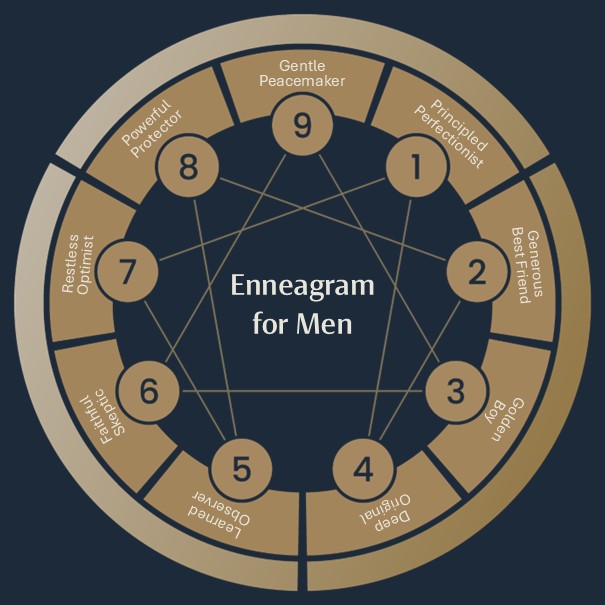
For now, I’m going to call him the Learned Observer. We can argue about the name later. What matters is where his story goes — because his growth edge is a strange one. He becomes wise, in the end, by being wise enough to be wrong.

How people see you
You’ll be the last to arrive at the office party, or Friday drinks. You’ll fetch your drink and slink back against the wall, and for any conversation to happen, people will have to approach you — not the other way around. They’ll get blunt, one-word answers for their trouble, right up until they mention they work in your field, at which point you light up and turn surprisingly animated.
Catch you at a conference surrounded by your professional kin, though, and you’re in the middle of the floor, as verbose as anyone — possibly one of the speakers. You’ll also leave the moment the subject-matter talk ends. You don’t hang around for the chit-chat.
In a meeting full of marketers and suits, you’ll listen quietly rather than jump in. You may have to be invited to speak, and even then you’ll feign a little shyness while your inner voice asks whether anyone will even understand. When you do speak, you tend to dump a few technical corrections, then land a pithy insight that either summarises or solves the whole problem. People are surprised you were listening at all, and ask why you didn’t say so earlier. You feign humility. If you weren’t invited to speak, you’ll catch the leader privately afterwards — you needed to think first, and to be sure you were “right.”
At home, your partner and kids often long for more contact than they get, and wish that when it came, it had a little more empathy and a little less mansplaining. Through all of it, you’re known for your “nutty professor” eccentricities and a quirky, often mistimed sense of humour — the ill-timed sharing of a Far Side cartoon being the classic tell.
How you see the world
For you, the world is objectively knowable, and something is only truly known once it’s been proved. Everything else is nonsense — emotions especially, since they can’t be measured or analysed, along with subjective opinions, anything New Age, and all small talk. Your motto runs roughly: if the world just followed logic, half its problems would disappear. The logic in question, of course, is your own — backed by data you’ve personally researched.
You believe there’s a right answer to everything, and that enough research will get you there. So you want plenty of data before you’ll decide, close a project, or publish. If other people supply the data, you’ll want to check it yourself before you trust it. The corporate world can feel stressful for exactly this reason — the pressure to speed up — when, left to your own devices, you’d happily take years. For you it’s about the journey of gathering data more than the destination of publishing.
You experience the world, in the form of people, as exhausting, demanding, intrusive and overwhelming.
You also experience the world, in the form of people, as exhausting, demanding, intrusive and overwhelming. There’s always some emotional drama that needs attending to, and the most annoying thing about it is that it pulls you away from your sweet spot — the work. So you retreat into your lair, your workshop, your study. You need more man-cave time to recharge than any other type here. You believe your energy is finite and ration your exposure to protect it — a frugality that tends to spread, until your surroundings turn minimalist and you’re quietly proud of how little you need to get by.

Why people like you
Let’s face it: it’s largely thanks to men like you that we have roads, bridges, rockets, cars, computers, software, smartphones, apps and the Internet. More than any other type, you can solve genuinely complex problems — you can work out how to build a bridge, or a rocket, using little more than numbers. You’ve programmed machines to do those jobs, to talk to one another, even to learn from one another. You’re scary smart.
Your subject-matter expertise is the cornerstone of modern society and of most businesses — the foundation off which every other type launches and expresses itself. The marketers, salespeople, negotiators, lawyers and project managers couldn’t do what they do if you weren’t applying your expertise in a back room somewhere.
And for all the nutty-professor scatter — forgetful, untidy, eccentric — you’re also grounded and reliable. You’re less likely than most to go chasing the next idea or the next deal. You’ll want to see this one through first, to research and test every angle before you give up and move on. People feel relatively safe with you. You’re going to be around.
Some find the eccentricity and unavailability intriguing, and are drawn in by the humour to see what lies behind the quirky exterior. They’re usually pleasantly surprised. And despite appearing aloof, you do listen — you observe, you know what’s going on, and you have good insights, which you’ll share if invited, and if you judge people worthy of hearing them. Those who aren’t trying to “fix” you come to value you for the wisdom you bring.
Why you drive people crazy
You’d think the roads and bridges and computers would be enough. They’re not. The world wants more from you — time, attention, small talk, hugs. It won’t be enough that you do a lot for humanity; you’ll get told you do too little for your family and friends.
You tick a lot of the boxes men get collectively criticised for. Offering a logical, fact-based explanation where a little sympathy would land better — mansplaining, in other words. Withdrawing into your study, which you need more than most men and will guard fiercely, so you’ll have that argument with your spouse on repeat. And when you do argue, you’ll insist on logic — your logic — to “win,” and you’ll count the argument won even if the other person plainly doesn’t.
You won’t accept anyone’s idea until you’ve researched it yourself, which can leave people feeling quietly undermined. Then there’s the data-gathering: you only trust others’ figures once you’ve examined them, so whoever’s deciding with you is forced to wait, even when their gut or their eye is already urging them on. Buying a house together, you want to research the market; your partner just loves the colour. You’d sooner miss the window than make a mistake.
Once you’ve made up your mind, you won’t easily change it. Think of Edison in The Current War, insisting AC was too dangerous long after the safety measures meant nobody was actually dying — he could simply have switched to it, cheaper and more practical, but he wouldn’t surrender the argument. You’re liable to do exactly the same, in your field and at home.

Your core fear
You offer the world the security of knowledge and data — the thing that lets it function reliably, and that in turn gives everyone else the confidence to express themselves. A lot depends on you. So it’s no surprise you carry a great fear of getting something wrong, of making a technical mistake. That’s the noble fear, and it’s the one you’ll name.
Underneath it sits a more personal one. It’s the fear of being pulled away from the work that matters to do something trivial — to make small talk, to handle people at an emotional level. Because socialising drains you. You don’t like to say anything stupid without having checked it first, and most social situations give you no chance to check. Worse, with emotions there’s no guidebook at all. You can never be sure what the right answer is, or what you’re supposed to say. So you stay away and bury yourself in facts, where the ground feels solid.
Most often, nobody is trying to catch you out. They’re just trying to connect.
Here’s the catch you’d rather not examine. Even your field — that supposedly objective world of data — is legendary for its politics and its bickering. You and your colleagues can get remarkably emotional about your facts and figures and what they mean. Which means you have emotions too. And where people keep turning out to be the problem, there’s one common denominator worth noticing. What you’re truly afraid of isn’t the wrong answer. It’s being found out — for not knowing. And almost nobody is actually trying to catch you out. They’re just trying to connect.
Your journey through the four stages of maturity
Every man’s road to maturity has the same shape. First he builds an ego and, with it, a shadow — the dark twin that quietly stores the data belonging to the one part of life he spends his days avoiding. For you, that avoided thing is the exhausting, exasperating world of people: their emotions, their dramas, their general — let’s be honest, this is how it feels to you — stupidity. You’re Yoda, muttering that the stupid is strong in these ones. You’re Scrooge, “Bah, humbug,” asking what facts could possibly support the whole business of Christmas.
You most likely grew up somewhere that humour, charm and social seduction either didn’t work, weren’t taught, or simply weren’t your gift. So you turned to your intellect to defend and bolster yourself, and you’ve felt safer with knowledge, data and facts ever since. You tell yourself you could handle people perfectly well if only there were no messy emotions — if only someone would write the manual. As an adult you make your escape by withdrawing into the intellect and refusing to reveal any idiocy, any feeling, in yourself. That single move supplies both the theme of your rebellion when you’re young and the theme of your complaint about the world a little later.

And then life goes to work on you. Slowly, without your consent, your shadow starts gathering evidence that proves you — yes — wrong. Not wrong about a fact. Wrong about the world being the harsh, humourless place your childhood taught you it was. At first you won’t pay it any attention. But the data accumulates, in the form of people and things that simply happen, until one day it starts to break through, and something in you registers that you no longer have to defend yourself the way you once did. Where that leads — what dawns on you, and what it costs — is the doorway this whole journey is built around.
Here’s the part almost no one expects. The opening doesn’t come by softening. Counter-intuitively, on the way into your thirties you’re more likely to withdraw further, not less — to become more certain, more one-sided, more the man who only speaks when he’s sure and only trusts data he’s checked himself. The shadow doesn’t knock politely. It waits until the one-sidedness has been pushed as far as it will go, and only then breaks through.
The great arc of your journey is learning to connect with others at t human and not a knowledge level.
You’ll travel four stages, and at each one you show up as a different man. In red you arrive as the Geek, the rebel convinced his knowledge will change the world. Then you become the Pedant, the white knight who knows what he knows. Grey, from your mid-thirties, is where the real turn either happens or doesn’t — where you can grow into the Professor, the man who finally knows what he doesn’t know. And black is reserved for the one who’s done the work: the Sage, wise, at last, enough to be wrong.
Where you get stuck in each of those stages — and exactly what it takes to break through — is the map I’ve drawn for you in the full report.
Download your Type 5 report — The Learned Observer — and walk your own journey from the Geek to the Sage, one stage at a time.
Neil Bierbaum is an Enneagram practitioner and leadership coach with more than 20 years in practice and over 500 type debriefs. He created the Four Stages of Male Maturity framework — adapted from the work of Carl Jung and Robert Bly — and The Enneagram for Men series, mapping each type’s path through the stages of maturity and the work of shadow integration. He works with men one-to-one through the Enneagram and the four stages of male maturity →.