He’ll drop everything to help you, then quietly resent that nobody thought to ask about him. Growth is the day his generosity learns to let a little back in.
A quick, tongue-in-cheek warning before we begin. This report is written for you — but in the third person. As “he,” not “you.” That’s deliberate. It’s highly unlikely you’ll ever read a report about yourself without someone else telling you to, because you’ll be so busy helping everybody else that you never give yourself the time or the attention. So we’ve written it as though we’re describing someone else. It’s a little tongue-in-cheek, and also completely realistic.
And if you’ve ever watched Queer Eye, you’ve already met your type — over-represented, episode after episode. Most of the people the Fab Five end up making over are Enneagram Twos: the pastor, the school sports coach, the single dad. The men so busy pouring themselves out for everyone around them that they’ve quietly disappeared from their own lives. This is a report about that man. About — whisper it — you.
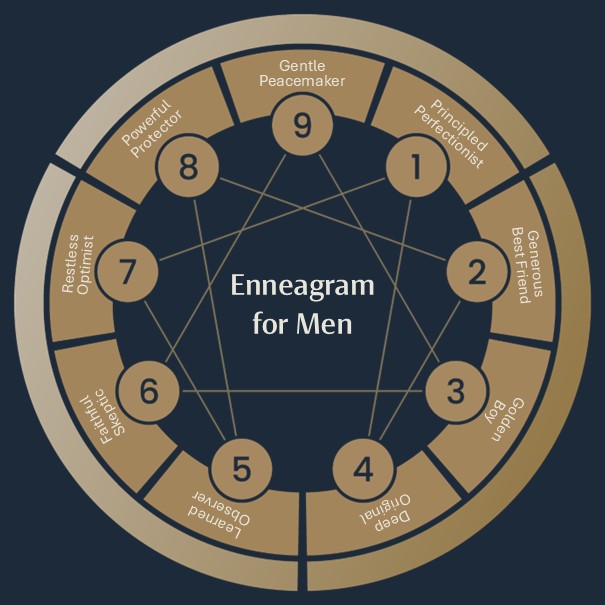
THE GENEROUS Best Friend can hardly stop himself. He spots people’s needs and pain points and jumps in before they’ve even named them. He appears totally selfless — and, for the most part, he believes it himself. What he’ll never admit, because he mostly doesn’t realise it, is that all of that helping is also quietly building and protecting his reputation as a generous, even selfless, person.
Picture your favourite, friendliest uncle — the one who’s a little out of shape because he’s neglected his own self-care while looking after everyone else. That’s not a rule (plenty of Twos are perfectly trim), but it captures the shape of him. His door is always open. His little black book is legendary. There’s always somebody having difficulty who needs him, which is wonderful news, because it means the supply never runs dry.
At a deep level, he carries a particular fear: that he might not actually be as generous as he makes out — that underneath it all he’s as selfish as everyone else, and, horror of horrors, that other people might see it.
At a low level of maturity, he can neglect himself, his partner and his children because he’s so busy saving the day for everybody else. At a high level, he becomes a genuine role model — think Desmond Tutu, or Bono, or, debatably, Robert Kiyosaki. Often, though, he’s hard to spot at all, because he’s always in the supporting role. Which is exactly where we’ll find him.

How people see him
He’s the heart and soul of any social event. He’ll probably arrive late — he stopped to do somebody a favour on the way — but once he’s there, he’s hard to miss. His warm-hearted ebullience spills over onto everyone around him. He might even be a little loud; his humour and laughter lift the room, though the more reserved types — the Type 5 Learned Observer and Type 1 Principled Perfectionist among them — may find it a touch intrusive.
People feel drawn to his warmth. What they see is what they get, and they sense he genuinely has their best interests at heart. He’ll listen eagerly and jump in with suggestions for whatever they’re wrestling with. He’ll offer to connect them with someone in his considerable network — a vet for the cat, a funder for the new business; it’s all in the book.
He tends to dress in a neutral, non-competitive style, maybe a little bunchy and untidy, accessories old and worn, pen branded from the last conference he attended. His car leans towards the average and nondescript. What looks like careless self-neglect he knows is also semi-cultivated: nothing about him should alienate anyone, or signal that he sits above them.
At work, his willingness to help means he often — let’s be honest, often — struggles to hit his own deadlines. In the performance review he’ll explain that everybody comes to him with their problems. His manager will nod, then gently point out that he’s his own worst enemy, because he never says no.
How he sees the world
The world, for him, is made of people, and people matter more than anything else. The best — and perhaps the only — way to build a relationship is to be kind, helpful and supportive, and there’s always somebody who needs exactly that. Even if they don’t know it yet. That’s not a burden; it’s a wonderful opportunity. It means there’s no scarcity of supply for him to do his thing, which is why he’s always busy, always motivated, always up and at ’em.
He’s refreshingly indiscriminate about who he spends time with. He won’t judge a man by his status, his situation or even his past. He’s more inclined than most to see everyone as equal, each person struggling in his own way. If anything, the one thing he will judge is judgement itself — watch him step in when the “Strict” Right Man starts assigning blame over a jammed photocopier. “I’m sure it was an accident. Here, let me fix that.”
He’s more inclined than most to see everyone as equal, each person struggling in his own way.
When the pressure rises in a team, he reckons it’s more valuable to lift people’s spirits than to reallocate the tasks. He wishes everyone saw it that way. He cares about his reputation, but far less for being seen as successful than for being seen as the generous helper.
He’ll insist he doesn’t mind giving, as long as the people he helps appreciate him. At a deeper level, he’s content as long as he’s being recognised as that generous, helpful person. And if they don’t appreciate him — if they take advantage — that’s when, privately, he’ll be hurt.

Why people like him
Gautama the Buddha said it first: life is suffering. Men like him are the antidote. He notices people’s suffering and steps in to lift them — and he’s grateful for the chance, because helping charges his batteries. The never-ending supply of people in need turns him into the world’s Energizer bunny.
That’s what he brings to any room, and especially to a team under pressure: the tougher things get, the more energy he pours in. His secret mission is to convert people from glass-half-empty to glass-half-full, and he’ll usually leave them lighter than he found them.
He has a marvellous network and a gift for connecting people — often suggesting the introduction before anyone’s thought to ask. He knows who they need, and he knows more people than they do. He could sell his little black book for a fortune, if only anyone knew who was in it.
He’s easy to be around, too. Salt-of-the-earth stuff: no airs, no politics, no pretence, no pressure. The most uncomplicated, straightforward man you’ll meet. Even the in-laws don’t mind having him over — they love him, and look forward to it. His door is always open and he’ll always make time.
There is just one person whose needs he’s a beat too slow to catch: the one who actually lives with him. He’ll fix the fridge, do the airport run, take his wife on the date night she needs — he just tends to pick that one up a little late. It’s the blind spot hiding inside the gift.
Why he drives people crazy
He’s out there so much, and for so many people, that his partner can start to feel he’s never really theirs. They’ll need to be very comfortable sharing him. They may also note, quietly, that it was all so different in the beginning.
Here’s the mechanism — and it’s true of all men. Once a partner is “locked in,” through commitment or marriage, they can slip down the order of priorities. Where another man might swing his attention back to his work, he swings his towards the people who aren’t locked in — the ones whose approval he still feels he has to earn. The wider family, the community committee, friends, friends of friends, the crisis at work. And if there isn’t a crisis, he’s quite capable of finding one: spotting someone being mistreated and charging in to help. Which can look, from the outside, a lot like interfering. Worse, all that problem-solving can quietly disempower the people he’s “rescuing,” who never get to struggle and grow on their own.
Then there’s the coaching problem. The moment his attention turns towards himself — which is precisely what insight requires — he reflexively recoils from the “selfishness” of it and flings his focus back outward, onto someone who needs him. So he’s genuinely one of the hardest men to reach. Offer him an insight and he’ll convert it, on the spot, into a practical tip for somebody else — leaving you unsure whether it ever actually landed.

His core fear
There are always two sides to the coin. There’s the light side, where he brings all that warmth and practical support to a world overflowing with need. And there’s the shadow — the side he doesn’t see, and in fact works hard to deny.
By helping others, he validates their needs and their feelings. The great irony is that while he lets everyone else have needs, he grants himself none. He almost tries to deny they exist; he certainly denies they matter. To have needs of his own — to actually attend to them — would be selfish, and selfish is bad. Being seen as selfish would be, for him, the worst thing in the world. That is his core fear.
He can’t be the only person alive without needs. Dig around and they’re there, though he’ll be the last to acknowledge them.
But apply a little logic and it falls apart. He can’t be the only person alive without needs. Dig around and they’re there — and buried inside all his helping is often his own quiet cry for help, his own hope that someone, someday, will reciprocate, or at least notice.
That belief — that having needs makes him bad — was learned early, when his survival depended on the people teaching it. It isn’t actually true. He won’t actually die by admitting he wants something. And here’s the part he’ll refute most fiercely: because nobody ever sees that he needs anything, he’s built his own private feedback loop, in the form of pride. He draws small, steady doses of it from being the generous one. That’s not a crime. It’s just the shadow, waiting to be owned.
Your journey through the four stages of maturity
Here’s where we switch to “you” — because this next part is yours to walk, and no one can walk it for you.
Every man’s journey to maturity runs the same basic shape: first he builds an ego and its inevitable shadow, and then — if he’s willing — he integrates that shadow back in. Your shadow holds the one thing you spend your life avoiding: the possibility of being seen as selfish. So the whole arc of your journey is really about discovering that there’s a real person in there — one who’s allowed to have wants and needs of his own, and who deserves to be valued in spite of, and not only because of, what he does for everyone else.

It unfolds across four stages, each with its own age range, its own colour, and its own character. There’s a red stage of rebellion in your late teens and twenties, where even your rebellion somehow comes out as service. There’s a white stage of compliance in your late twenties and thirties, where you become everyone’s indispensable fixture. There’s a long grey stage of integration from your mid-thirties into your fifties — the one everyone calls midlife, where the shadow finally starts knocking. And there’s a black stage of wisdom from your late fifties on, if you’ve done the work to get there.
Here’s the counter-intuitive part, the bit most men miss. You’d assume that maturing means softening the helper — dialling him down early. It doesn’t work like that. Going into white, the helping actually intensifies. You become more of it, not less: more generous, more available, more indispensable, more one-sided. Your great strength gets turned all the way up, right to the point where it starts to curdle into something people find just a little too much. That’s not a detour off the path. That is the path. The over-giving has to reach its fullest, most one-sided expression before the thing hiding underneath it — the pride, the unmet needs, the quiet hope of being appreciated — can finally break through in grey.
The great arc of your journey is to learning to say yes on your own terms.
And when it breaks through, it won’t feel like wisdom arriving. It’ll feel like something going wrong. It’ll dawn on you, slowly and against your will, that you don’t have to say yes every single time — that other people say no and still have friends, still get loved, and the sky doesn’t fall. Horror of horrors: you can set a boundary and survive it. You might even be the better for it.
What actually happens inside each of those stages — where you get stuck, what specifically breaks you open, how you move through — is the map we’ve drawn in the full report. Here, we’ll just introduce you to the four men you’ll be along the way.
That’s the shape of the journey. What we’ve left out — deliberately — is what happens inside each stage: exactly where the Nice Guy gets stuck, what finally cracks the Go-To Guy open, how the Supporter either integrates or quietly regresses, and what it truly costs to reach the Mentor. That’s the real work, and it’s what the full report walks you through, one stage at a time.
Download your Type 2 report — The Generous Best Friend — and walk your own journey from the Nice Guy to the Mentor, one stage at a time.
Neil Bierbaum is an Enneagram practitioner and leadership coach with more than 20 years in practice and over 500 type debriefs. He created the Four Stages of Male Maturity framework — adapted from the work of Carl Jung and Robert Bly — and The Enneagram for Men series, mapping each type’s path through the stages of maturity and the work of shadow integration. He works with men one-to-one through the Enneagram and the four stages of male maturity →.