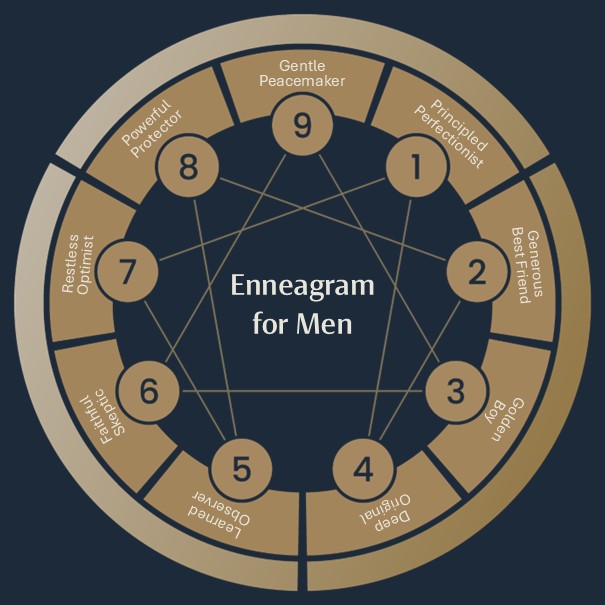
He keeps the peace, usually at his own expense. Maturity is the day that his easy calm grows a spine — a diplomacy that can, when it matters, finally state a demand.
SOME MEN fix the world by force. The Type 9 man — the Gentle Peacemaker — fixes it by making sure nobody ever has to fight over it in the first place. He is just as attuned to the imperfections of the world as anyone, and just as quietly idealistic about smoothing them over. But instead of abstracting or theorising, he reads the room. He has a gut sense for exactly where the disharmony and conflict sits in any group, and an instinct to dissolve it. It can exhaust him, and there are days he’d rather withdraw back into the clouds and take a nap.
When his desire to fix it wins, though, he’ll spend his energy listening to everybody’s point of view and gently counselling them toward each other. You’ll find these men as pastors, mediators and political negotiators — or in perfectly ordinary careers, where they’ll still end up being the peacemaker in one form or another. At a deep level, what he fears is that conflict will destroy the relationship, and by extension the world. He simply doesn’t see the need for, or the upside of, any form of conflict.
At a low level of maturity, that looks dreamy, passive, even withdrawn — decisions on hold, going along with everyone else’s. At a high level, he leads as a great diplomat, in the mould of Jimmy Carter or Pope Francis. This series is about that journey: how one enneagram style travels the four stages of male maturity. Here’s the Type 9 map — and his growth edge is a diplomacy that can also demand.
How people see you
In one sense, you might be the ultimate strong, silent type — though your strength is less the strength of forceful aggression than the strength of calm stillness in the face of it. You’re rarely the target of aggression; who’d bother, you’re such a calm guy. More often you’re the witness to it, and as a witness you’ll be tempted to step in and quietly sort things out.
That air of calm can lead some people to pay you less attention. You’re not the life and soul of the party. Yet others find the silence intriguing — wondering what secrets you’re hiding, or what wisdom you’re holding onto.
When there’s a decision to be made, you won’t be the one steering it. You’ll wait and see what the majority want and lean that way — though not before making sure the minority voices were heard. Nobody’s surprised when you step in as an arbiter if things get heated, whether it’s which club to go to after dinner or the deliberations of a whole political movement. Cyril Ramaphosa, lead negotiator in the talks that ended apartheid, is the type here.
The flip side, as Ramaphosa also discovered, is that people may criticise you for not pressing home your own advantage. Instead of “going for the kill”, you go for “don’t rock the boat” — a phrase you say rather a lot. And those close to you know you don’t rock the boat anywhere in your life. You’ll hold the bags, take the nap, and stay wonderfully, maddeningly steady.
How you see the world
From where you sit, it’s a dog-eat-dog world — people forever pressing for their wants and needs, forever colliding. You’re convinced that if you voice your own wants, you’ll just add fuel to the fire. Worse, the more aggressive types won’t like it, and that could destroy the relationship, which for you is close to the worst thing imaginable.
So you’d rather be the cement between the bricks, the glue between the parts, than a brick yourself. You find a place that works well enough, filling the gaps, not trying to stand out. The one part you’ll play is to listen, mediate, arbitrate and advise, all in the service of harmony. You’re a genuine peacemaker.
You have a strong gut sense of where the tensions are in any group, and it can overwhelm you.
The world “out there” occupies a lot of your attention. You have a strong gut sense of where the tensions are in any group, and it can overwhelm you — often to the point where you “can’t think”. When that happens you’ll distract yourself with mundane, less important tasks. In extreme cases you’ll go and lie down, and perhaps even take a nap.
You tend to treat other people’s views and needs as far more important than your own. Pressed to state yours, your mind goes blank; it’s just so much easier to go with the flow than to work up a list of demands. You’ll fetch another book by the same author rather than face a whole bookshop. And what, exactly, is wrong with the bands you loved ten years ago?

Why people like you
You’re so easy-going — what’s not to like? While everyone else is making noise and making demands, you’re the one who offers relief from all of it. You’re the person others can just turn to and offload, or rope into a round of golf when no one else will come.
As a partner, you’re a safe haven where someone can vent without being needlessly challenged. You’ll listen, nod, agree, and genuinely understand. When it counts, you’ll go along with whatever she needs — tag along on the shopping trip, or happily wave her off on it. Your home has an air of peace and tranquillity. Your kids may count themselves lucky to have a “chilled dad” who lets them hog the TV and quietly lets the odd late gaming night slide.
You’ll take advice — about clothes, habits, even big career calls — and you’ll often seek it. Early on, your partner’s friends will say she’s found a real keeper. Which is true, of course. Though only if she wants to keep you, ha ha.
You won’t boss anybody around — not your partner, not your kids, not your staff. If anything you’ll let them do the bossing and go along with it. So you’ll run a genuinely democratic workplace where everyone feels heard and safe to take risks, because nobody gets their head chopped off for a mistake. That safety breeds innovation, engagement and real ownership. It’s a gift — right up until it isn’t.
Why you drive people crazy
Sometimes your partner wants you to stand up for her — or to her. It’s possible to take the agreeability thing too far. There are moments that call for you to negotiate a better price on the house, or to challenge the headmaster about how a Coach treats your child. When you don’t, she notices that you also never stand up to her. That can curdle into something close to contempt.
If it does, she may say so outright. Or, knowing you won’t fight back, she may mirror you and go passive-aggressive — unwittingly showing you the very thing that grates: that you say yes without meaning it, then do the thing half-heartedly. She might even wonder aloud whether you’d bat an eyelid if she were having an affair. Careful she doesn’t decide to test that theory.
Other habits start to nag, too — the way you’ll bury yourself in a crossword when a real decision is due, or your loyalty to the same authors, bands and shows year after year.
At work it shows up as ducking conflict. You’ll leave it, hoping it sorts itself out, or refuse to take a stand even in a clear-cut case. Sometimes you’re right and it does resolve. But the corporate and political worlds often demand decisive action, fast — and when you can’t supply it, people start talking behind your back. Pushed, you respond with something that looks a lot like stubbornness. They begin to see you as weak, even insincere. And so your peacekeeping quietly manufactures the very uprising you were trying to prevent.

Your core fear
You offer the world a glimpse of what it might look like if everyone could just get along — and you make it seem almost possible. But nothing is quite as it seems. There’s a dark side driving all that peace-loving, and it has to do with your own life force, your will — the thing most of us experience as anger.
Some men handle anger well. They light a small fire in the fireplace and use its heat: they have the awkward conversation, set the boundary, hold their ground, and when it’s over the fire dies down and they carry on. Others can’t contain it — they light a bonfire in the middle of the floor and burn the house down.
To prevent someone else lighting a bonfire, you avoid lighting even the smallest flame.
Here’s your particular fear: that every fire you light, however small and contained, will be met by someone else lighting a bonfire. You anticipate that any time you assert your will — say what you think, ask for what you want, set a boundary — the other person will flare up, rage, and ultimately reject you. So you avoid lighting even the smallest flame.
On the surface this reads as a fear of conflict, and beneath that a fear of losing the relationship and ending up alone. But at the core it’s something else again — a fear of your own life force, and of what it might do if you ever let it out. What that fear is really protecting, and what happens when you finally stop feeding it, is where your real story begins.
Your journey through the four stages of maturity
Every man’s journey to maturity runs the same broad course: the ego forms, its dark side — the shadow — forms with it, and then, hopefully, that shadow gets integrated. Your shadow holds the data belonging to the one thing you spend your life avoiding: the conflict you’re sure will erupt if you ever express your own point of view, your own wants, needs and feelings.
It usually starts young. Maybe you were the middle child among more aggressive siblings, or at the mercy of a domineering parent. Going along with them — reading them, even arguing their case for them — was a survival strategy. So as an adult you deny that you have any wants or opinions at all, suppress that inner voice, and fuse yourself instead to what other people want. That go-with-the-flow stance becomes the theme of your rebellion in youth and, later, your quiet critique of the world: you’ll object to all that pushy, conflictual behaviour by withdrawing, going silent, and finding other elegantly passive ways to make your point.
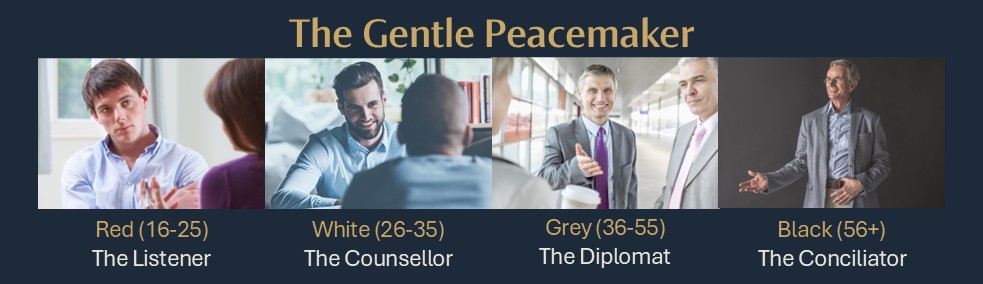
Here’s the twist most men don’t see coming. As you move into the second stage, you don’t loosen this — you double down. You become more diplomatic, more accommodating, more the exemplar of harmony, until you’re almost a caricature of the peaceful man. The one-sidedness intensifies. And precisely because it does, life starts handing you the contradictory evidence — the postcards from the edge suggesting the world may not be the place your childhood told you it was. At first you’ll ignore them. Then, somewhere in midlife, they start to break through, and it dawns on you — horror of horrors — that you might not need to make yourself invisible after all. That you can want things, say things, ask for things, and the sky won’t fall on your head. That people don’t actually abandon you every time. And on the rare occasion they do, well, it turns out that isn’t the end of the world either.
The arc of your journey is to learn that you can want things, say things, ask for things, and the sky won’t fall on your head.
What you do with that dawning is the whole game. Across the four stages you travel as four different men: the Listener, the Counsellor, the Diplomat, and finally — if you let the shadow do its work — the Conciliator, who can lead every bit as much as he can follow. Where each of those men gets stuck, what breaks through, and exactly how the quiet one finds his voice is the map we’ve drawn for you in the full Type 9 report. The door is right here. Whether you walk through it is, for once, entirely your call to make.
Download your Type 9 report to walk the full journey stage by stage — and to find out what the Gentle Peacemaker discovers when he finally lets himself be heard.
Neil Bierbaum is an Enneagram practitioner and leadership coach with more than 20 years in practice and over 500 type debriefs. He created the Four Stages of Male Maturity framework — adapted from the work of Carl Jung and Robert Bly — and The Enneagram for Men series, mapping each type’s path through the stages of maturity and the work of shadow integration. He works with men one-to-one through the Enneagram and the four stages of male maturity →.